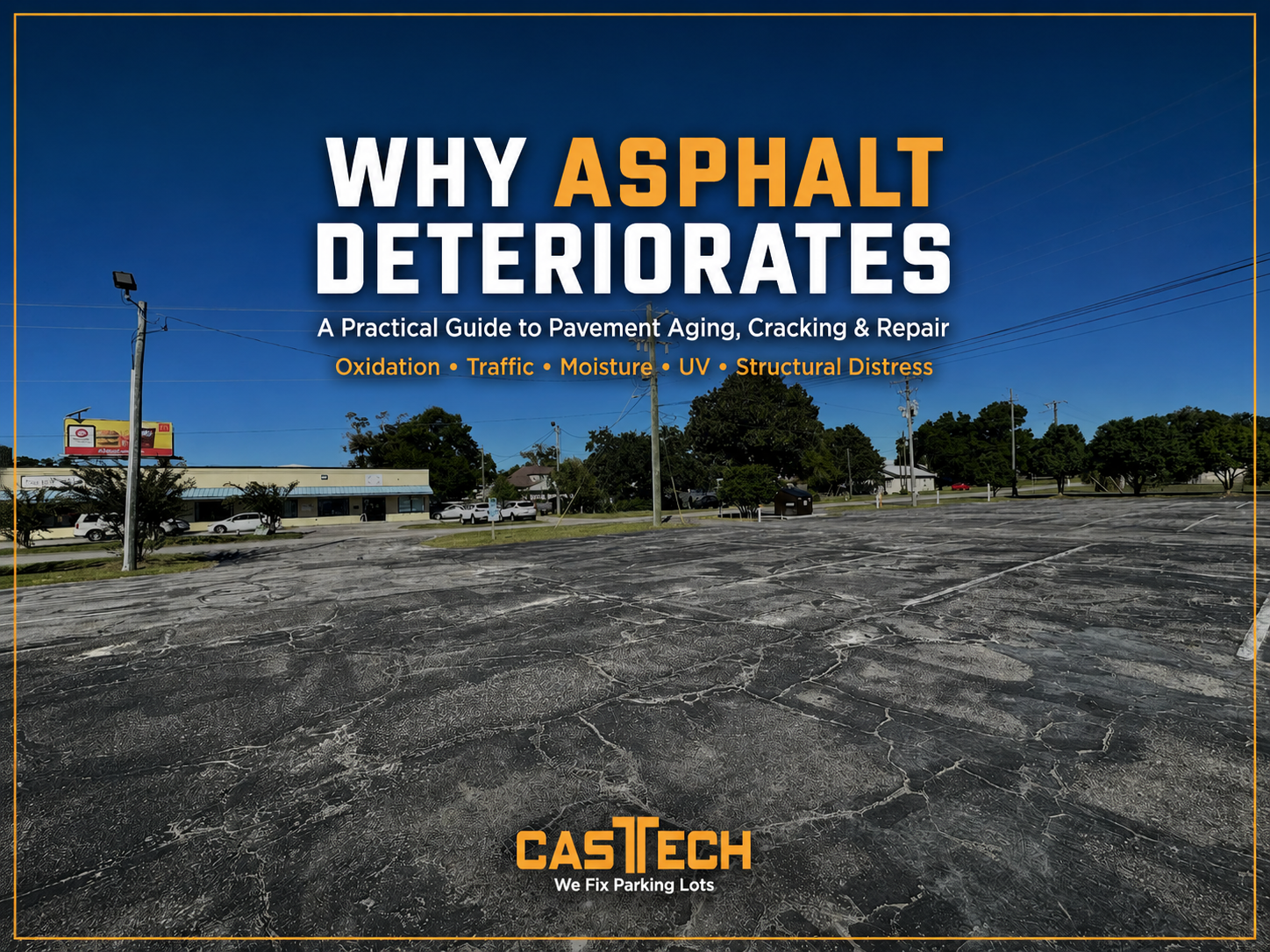
When we review damaged asphalt, we look for the reasons it is wearing out as well as the visible defects. Traffic, water, weather, and the pavement’s construction all influence the repair we recommend. Understanding those factors helps you make sense of the options in a maintenance proposal.
What asphalt is and why it ages
Asphalt pavement (often called asphalt concrete) is aggregate bonded by asphalt binder (bitumen). The binder provides cohesion, flexibility and water resistance; aggregates provide strength and texture. The binder’s chemical and physical changes over time are central to pavement aging and distress.
- Asphalt binder provides cohesion, flexibility and resistance to water.
- Aggregates provide structural strength and surface texture.
- Pavement performance depends on mixture design, layer thickness and compaction.
Primary mechanisms of asphalt deterioration
Several mechanisms drive deterioration. They typically act together and accelerate one another.
- Oxidation (aging): Oxygen reacts with the binder, making it stiffer and more brittle. Oxidation begins at the surface and works downward, increasing cracking risk. According to the Asphalt Institute, oxidation is the dominant long-term aging process affecting binder flexibility.
- Ultraviolet (UV) radiation: Sunlight breaks molecular bonds in the binder, speeding oxidation and surface embrittlement.
- Thermal stress and temperature cycling: Daily and seasonal temperature swings cause expansion and contraction; repeated movement can cause thermal and reflective cracking.
- Fatigue cracking: Repeated traffic loading can contribute to interconnected cracking that develops into an alligator-like pattern. This should be distinguished from cracking caused by temperature changes. The FHWA pavement distress guide illustrates the patterns used to identify pavement distress.
- Rutting and deformation: Heavy or slow-moving loads shear or compact surface layers, creating wheel-path rutting and profile loss.
- Moisture damage: Water can strip binder from aggregates (stripping) and weaken base materials. The Federal Highway Administration details how poor drainage and moisture accelerate structural failure.
- Chemical contamination: Oils, fuels and de-icing chemicals can soften or strip the binder and accelerate local deterioration.
How environmental factors accelerate deterioration
Local climate and site conditions determine which mechanisms dominate and how quickly pavement fails.
- Hot climates: Promote binder softening, rutting, and faster oxidation at high temperatures.
- Cold climates: Cause thermal cracking, freeze–thaw cycles, and greater susceptibility to moisture freeze damage.
- Wet climates and poor drainage: Encourage moisture penetration and base weakening, turning surface cracks into structural failures faster.
- Solar exposure: Direct sun increases UV-driven oxidation; shaded areas can age more slowly at the surface but may still suffer structural issues.
Construction and material factors that matter
Pavements with identical traffic and climate can perform very differently depending on design and construction quality.
- Mixture design: Insufficient binder, poor aggregate gradation, or the wrong binder type reduces durability.
- Compaction: Too many interconnected air voids allow air and water into the pavement. Too little void space can leave the mixture unstable in hot weather. The Asphalt Institute’s compaction guidance explains why the specified density matters.
- Layer thickness and drainage: Insufficient structural thickness or inadequate base/subbase drainage leads to early structural failure.
- Traffic loading: High loads, turning, and stop/start movements produce localized stresses (wheel-path rutting, shoving).
- Poor joint construction: Weak transverse and longitudinal joints are frequent initiation points for cracking and water ingress.
Typical signs and progression of distress
Recognizing early warning signs helps prioritize maintenance before more expensive repairs are required.
- Surface fading and loss of sheen: Early oxidation and UV exposure.
- Small transverse and longitudinal cracks: Often due to thermal movement or surface brittleness; these are usually repairable by sealing.
- Alligator (fatigue) cracking: Indicates structural failure of surface layers and typically requires patching or full-depth repair.
- Rutting and depressions: Point to consolidation or deformation—may require milling and overlay or base repair.
- Potholes: Advanced localized failures where water and traffic remove material—rapid repair is needed for safety.
Maintenance, prevention and repair strategies
Appropriate maintenance extends pavement life, reduces lifecycle cost and improves safety. A mix of preventive and corrective treatments is usually best.
- Preventive maintenance: Sealcoating and crack sealing slow oxidation and prevent water entry; most effective when cracking is limited.
- Surface treatments: Chip seals, slurry seals, or thin overlays rejuvenate the surface and restore skid resistance.
- Rehabilitation: Milling and overlay, full-depth patching, or reconstruction when structural failure exists.
- Fix drainage and base issues: Correcting subgrade or drainage problems can stop recurring failures and protect repairs.
- Right materials for the site: Use binders and mixtures suited to local climate and traffic. Polymer-modified binders can improve performance in high-stress areas.
Frequently asked questions
Q: How fast does asphalt deteriorate? A: There is no single service life for every parking lot. Construction quality, pavement thickness, traffic, drainage, climate, and maintenance all affect how the pavement performs. We review visible distress and any available repair history when recommending work; age alone does not determine whether a lot needs preservation, an overlay, or reconstruction.
Q: Can crack sealing really extend pavement life? A: Yes. Sealing cracks prevents water infiltration and slows binder oxidation at crack edges. Timely crack sealing is one of the most cost-effective preventive measures and can delay larger repairs.
Q: When is an overlay enough versus full reconstruction? A: Overlays work when surface distress exists, but the base layers remain structurally sound. Widespread base failure, severe alligator cracking, or persistent deep rutting generally require full-depth patching or reconstruction. A site review or structural evaluation will determine the correct approach.
Q: How do I choose the right contractor or pavement material? A: Choose contractors experienced in local conditions, with solid references and transparent material specifications. Ask for mixture designs, compaction records, and quality control documentation. Our service pages explain the material and service options we offer.
Further reading
- Asphalt Institute — asphalt materials, construction, and maintenance resources.
- Federal Highway Administration Pavements program — pavement design, materials, preservation, and rehabilitation resources.
- National Asphalt Pavement Association — asphalt pavement information and industry resources.
Discuss the condition of your pavement
Contact us or call (850) 860-0014 to discuss your property location and the damage you are seeing. We’ll arrange the appropriate assessment and explain the repair or preservation options that fit the lot.