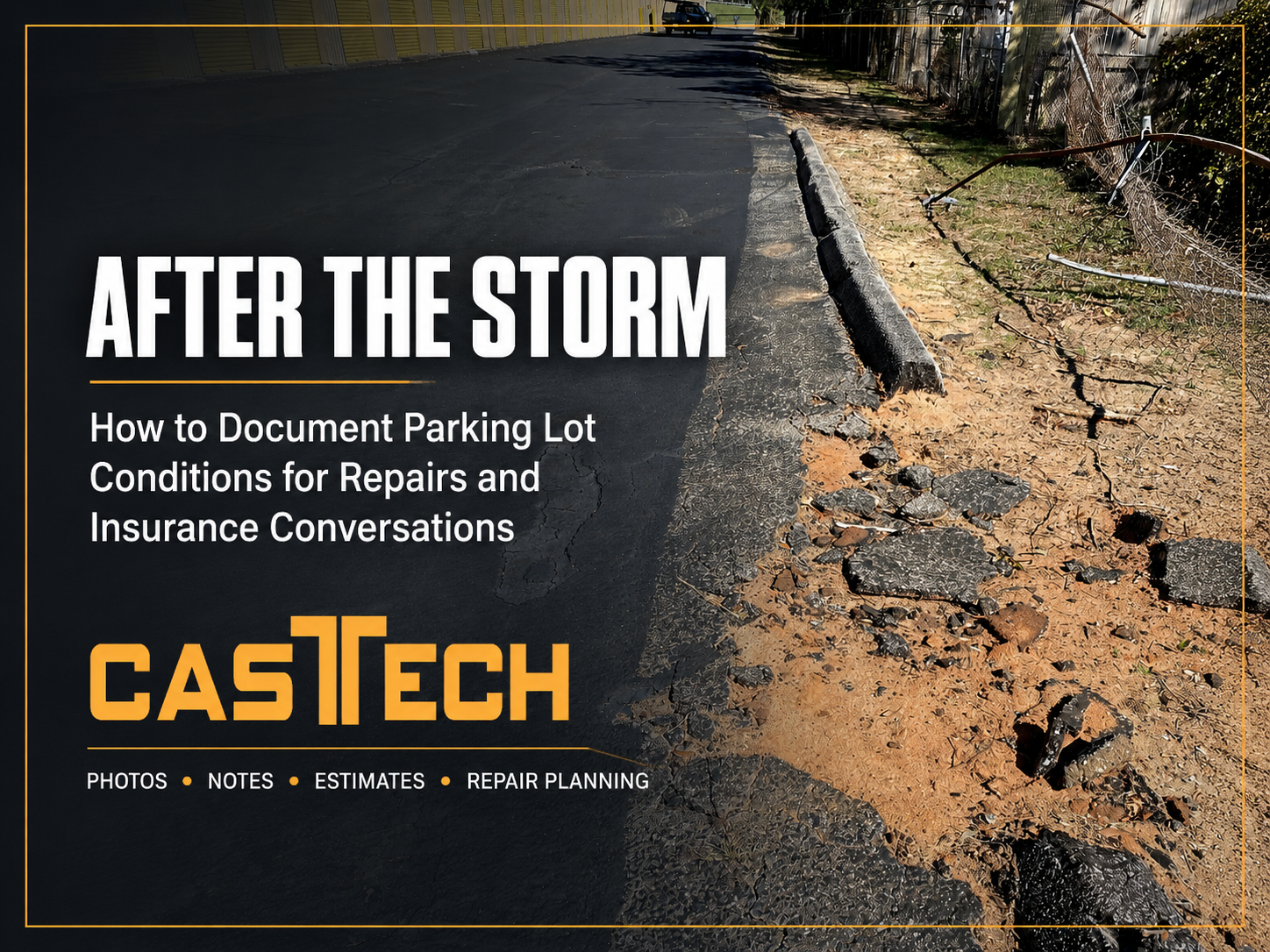
We help property managers review pavement concerns before hurricane season so there is time to discuss repairs, access needs, and scheduling. This checklist gives your team a way to organize visible issues and share the priorities we should consider during a site assessment.
Pre-season visual sweep: standing water and drainage
Start with drainage because water that pools during heavy rains causes the fastest, most expensive pavement damage. Walk the lot after a moderate rain when possible to see problem areas.
- Identify low spots and areas of standing water that don’t drain within 24–48 hours.
- Check catch basins, grates, curbs, and swales for debris, silt, leaves, or trash that block flow.
- Confirm gutter downspouts and roof runoff aren’t dumping directly into the pavement without controls.
- Note areas where surface water flows toward building foundations or into landscaped areas that could carry silt back onto the lot.
- Report blocked drains and recurring ponding to your property team and our team. The appropriate maintenance or drainage contractor can assess clearing needs; we can coordinate approved pavement repairs with that work.
Potholes and cracks: what to check and prioritize
Hurricanes bring repeated heavy rain; small defects can grow quickly. During your audit, tag and prioritize defects for repair before the peak storm window.
- Locate potholes, map their positions, and note depth and width — deep or multiple potholes in one area should be the top priority.
- During a pavement review, we distinguish suitable linear cracks for crack sealing from alligator cracking, potholes, and failed areas that need a different repair.
- Look for undermined pavement edges and soft spots near drains and islands where subsurface erosion has started.
- We can prioritize the proposed pavement repairs around entrances, drives, drainage paths, and emergency-access needs identified with your facility team.
- We assess the pavement, proposes priorities, and performs the approved repairs before storms when conditions and scheduling allow. See our asphalt maintenance options for the services available.
Hardscape and safety hardware: wheel stops, signage, and markings
Damaged or loose parking hardware warrants professional review before storm conditions arrive. We can assess the wheel stops and signs and carry out the approved replacements; your facility team maintains the emergency-access arrangements.
- Inspect wheel stops and curb blocks — look for cracked, loose, or displaced units that can become projectiles or trip hazards.
- Check all signage (stop, directional, parking, fire lane, and ADA signs) for damage, reflectivity, and secure mounting hardware.
- Assess painted markings: faded fire lanes, arrows, handicapped stalls, and directional markings need re-striping to remain visible to first responders. Schedule line striping if visibility is poor; see our line striping services.
- Confirm accessibility markings (ADA stalls and pathways) are intact and unobstructed so emergency responders and tenants with disabilities have safe access.
Emergency access routes and staging areas
Make sure emergency vehicles have uninterrupted access and that staging areas are identified and maintained.
- Verify primary and secondary emergency access routes are free of vegetation, debris, parked cars, and temporary obstructions.
- Keep fire lanes clearly marked and unobstructed; remove or reassign tenant parking that blocks these routes during storm season.
- Identify safe staging areas for generators, recovery crews, and supply trucks that are elevated and away from known flood zones.
- Coordinate with building tenants and security to maintain clear routes during alert periods and communicate parking restrictions in advance.
Post-storm inspection planning and documentation
A quick, organized post-storm inspection reduces downtime and speeds recovery. Prepare a documentation plan now so the responsible teams can plan their response once access is safe.
- Create a simple post-storm checklist that mirrors your pre-storm audit: drains, potholes, cracks, signage, wheel stops, and access routes.
- Assign inspection zones and responsible staff or contractors to ensure full coverage and faster triage.
- Document damage with dated photos and notes for repair planning and insurance claims. Prioritize safety hazards and anything blocking emergency access.
- Have contact info and preferred contractors ready. For a professional post-storm property assessment or prioritized repair quote, schedule a site review with our assessment team.
Keeping this seasonal checklist on file helps you act quickly, protect pavement structure, and maintain safe access during hurricane season. For targeted repairs, re-striping, or a formal site assessment before storms arrive, request a site review with us or visit our maintenance pages for more details:
- Schedule a Site Review / Assessment
- Asphalt maintenance and repairs
- Line striping and pavement markings
- Learn more about pavement deterioration
Frequently Asked Questions
When should I perform the pre-hurricane parking lot audit?
Perform the audit before the official start of hurricane season and again immediately if a named storm is forecast to impact your area. Ideally, schedule a baseline inspection in late spring to identify and fix vulnerable areas before peak activity.
Can temporary fixes help if a storm is imminent?
Temporary controls should be selected and installed by personnel qualified for the conditions. Your property team can coordinate access restrictions and report damage; we can assess pavement concerns and perform approved repairs when the site is safe. A temporary measure does not replace the required permanent work.
Which pavement issues should be prioritized after the storm?
Prioritize anything that creates safety hazards or blocks emergency access: large potholes on traffic routes and entrances, undermined pavement at edges, damaged signage, and obstructed drains. Document damage for insurance and schedule permanent repairs promptly to avoid accelerated deterioration.
How can we help my property prepare for hurricane season?
We provide pre-storm pavement assessments, prioritized repair quotes, asphalt maintenance, and line-striping services. Our team explains the proposed work and coordinates the approved repairs with your property’s operating needs.
If your property needs pavement repairs before hurricane season, contact us or call (850) 860-0014 to discuss the location, priorities, and available work window. We’ll confirm the appropriate assessment and scheduling options with you.