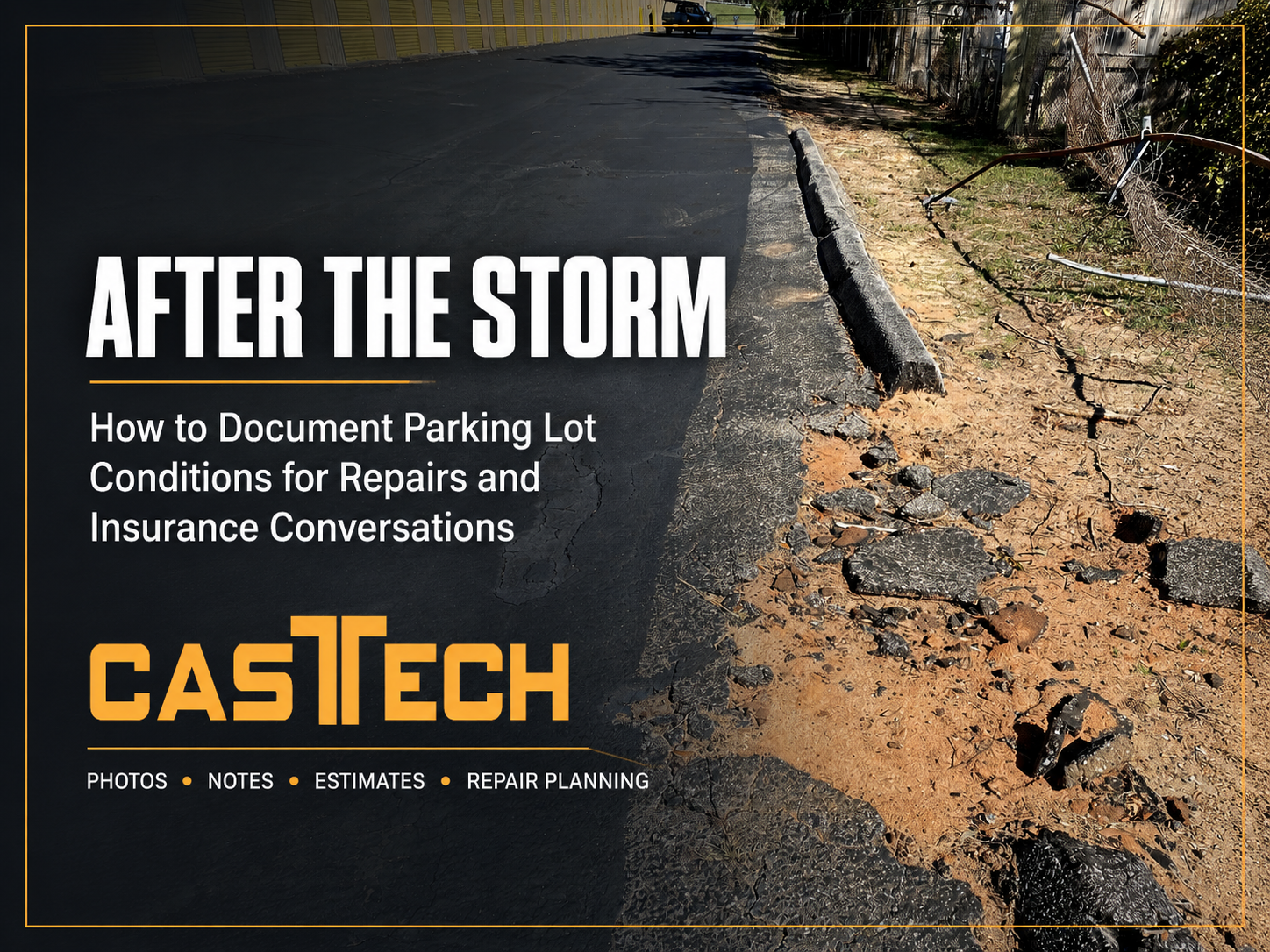
This article provides general parking lot documentation and maintenance guidance only. It is not legal advice, insurance advice, engineering advice, public-adjusting advice, or a promise of claim coverage or approval. Property owners and managers should contact their insurance carrier, adjuster, attorney, engineer, or other qualified professional for claim-specific, coverage-specific, or safety-critical guidance.
When you contact us about parking lot damage after a storm, clear photos and location notes help us understand the visible repair concerns. Keeping those records organized also helps your property team communicate with the insurer or adjuster, who should provide the claim-specific instructions.
Safety first before entering the property
Do a safety assessment from a distance before walking the lot. Prioritize human safety and confirm local authorities allow re-entry.
- Check for downed power lines, gas leaks, unstable structures, deep standing water, and sinkholes.
- Do not enter unsafe areas. If authorized and trained personnel must access the site, use PPE appropriate for the conditions. PPE may include a hard hat, high-visibility vest, gloves, waterproof boots, eye protection and any additional equipment required by the site hazards.
- If utilities are compromised, wait for utility crews and first responders to clear the site.
- Keep people away from unsafe areas. If it can be done safely by authorized personnel, use cones, barricades or caution tape to restrict access. Do not approach hazards just to take a better photo.
Take wide photos and close-ups before cleanup
Photos and videos can help property owners, managers, insurers, adjusters and repair contractors understand visible site conditions after a storm.
- Start with wide shots to show context—entrances, building façades, and surrounding landmarks.
- Follow with close-ups of damage areas; include a recognizable object (coin, measuring tape) to show scale.
- Record short video walkthroughs with slow pans and narration describing damaged areas—video timestamps help.
- Keep original camera files when possible. Avoid cropping, filtering or heavily editing images that may be shared with the property owner, insurer, adjuster or repair contractor.
Capture time/date, location, and affected areas
Make each photo and video easy to match to a specific area of the property. Keep metadata when possible, note GPS locations if available and maintain a written log linking images to specific lot zones.
- Use devices that preserve EXIF metadata or enable GPS/photo timestamping.
- Create a simple damage log: photo file name, date/time, camera used, zone or stall numbers, and a one-line description.
- Map or sketch the lot and mark photographed areas for quick reference during inspections, repair planning and insurance conversations.
Photograph these specific parking lot features
When safe, document visible conditions systematically. Your insurer, adjuster, property owner, or repair contractor may ask for photos of common damage areas.
- Asphalt and concrete cracks, potholes, pavement washouts, and undermining.
- Areas of scour or erosion around drains, curbs, islands, and slopes.
- Damaged or missing signage, lighting poles that are bent or leaning, and displaced wheel stops/curbs.
- Striping damage, faded markings, and blocked drainage inlets or pipes.
- Debris impact on pavement, parked vehicles, landscaping, and visible contaminants, sediment, oil sheen, or chemical spills.
Keep repair estimates, invoices, receipts, and correspondence
Organized records can make repair planning, internal approvals and insurance conversations easier to follow.
- Collect written repair estimates and work orders that reference photo file names and location markers.
- Save invoices, permits, payment receipts, and before-and-after photos for every completed repair.
- Scan and store documents in a secure folder or cloud account; maintain a backup copy offsite.
Organize pre-storm and post-storm records separately
Organize pre-storm and post-storm records separately when possible. Prior photos, maintenance logs, and inspection reports can help property owners and managers explain what changed after the storm. Your insurer, adjuster, engineer or other qualified professional should determine how policy terms apply to observed conditions.
- Provide maintenance logs, previous inspection reports, and pre-storm photos where available.
- Note areas with prior patches, oxidation, or long-term cracking versus sudden displacement or washout after the storm.
- If conditions are unclear, request a professional site assessment to document visible parking lot conditions and recommended repair needs before permanent repairs begin.
Contact the insurance carrier or agent for claim-specific instructions
Notify your carrier promptly and follow any claim-specific documentation requirements. Some insurers or adjusters will instruct you to wait for an inspection before major cleanup.
- Ask the insurer whether they require an adjuster on site before debris removal or temporary repairs.
- Ask your insurer or adjuster how they prefer to receive photos, estimates, receipts and repair documentation.
- Keep copies of all email exchanges and claim numbers; if the insurer provides contractor referrals or vendor instructions, keep those records and still verify licensing, insurance, and scope of work before authorizing repairs
Use licensed and insured contractors
Hire contractors who are licensed, insured, and experienced with post-storm repairs. Verify credentials and get written scopes of work.
- Require proof of licensing, insurance certificates, and references for similar work before authorizing repairs.
- Get detailed written estimates that separate emergency stabilization, full repair scope, materials, labor and permits so property owners, managers, insurers and adjusters can review the proposed work more clearly.
- Document contractor start and completion dates, and photograph completed work for your property records, repair documentation, and any insurer-requested documentation.
We can document visible parking lot conditions and provide repair recommendations related to pavement, striping, signage, wheel stops, drainage concerns, and traffic-control features. We do not provide insurance, legal, engineering, or public adjusting services. Property owners should consult their insurance carrier, adjuster, attorney, engineer, or other qualified professional about claim requirements, coverage, causation, or safety-critical concerns.
FEMA’s National Flood Insurance Program recommends photographing and filming damage before cleanup, keeping samples and receipts, and providing documentation to the adjuster. The U.S. Chamber Foundation gives similar guidance: document damage with photos or video, contact your insurance company, keep receipts, obtain repair quotes, and track recovery expenses. These general practices can help property owners keep repair and damage records organized when communicating with insurers, adjusters and repair vendors.
If you would like us to document visible pavement concerns or discuss repair needs, contact our team or call (850) 860-0014. We’ll review the location and arrange the appropriate next step once access is safe. Our assessment supports repair planning and property maintenance; it does not prepare or negotiate an insurance claim or determine coverage.