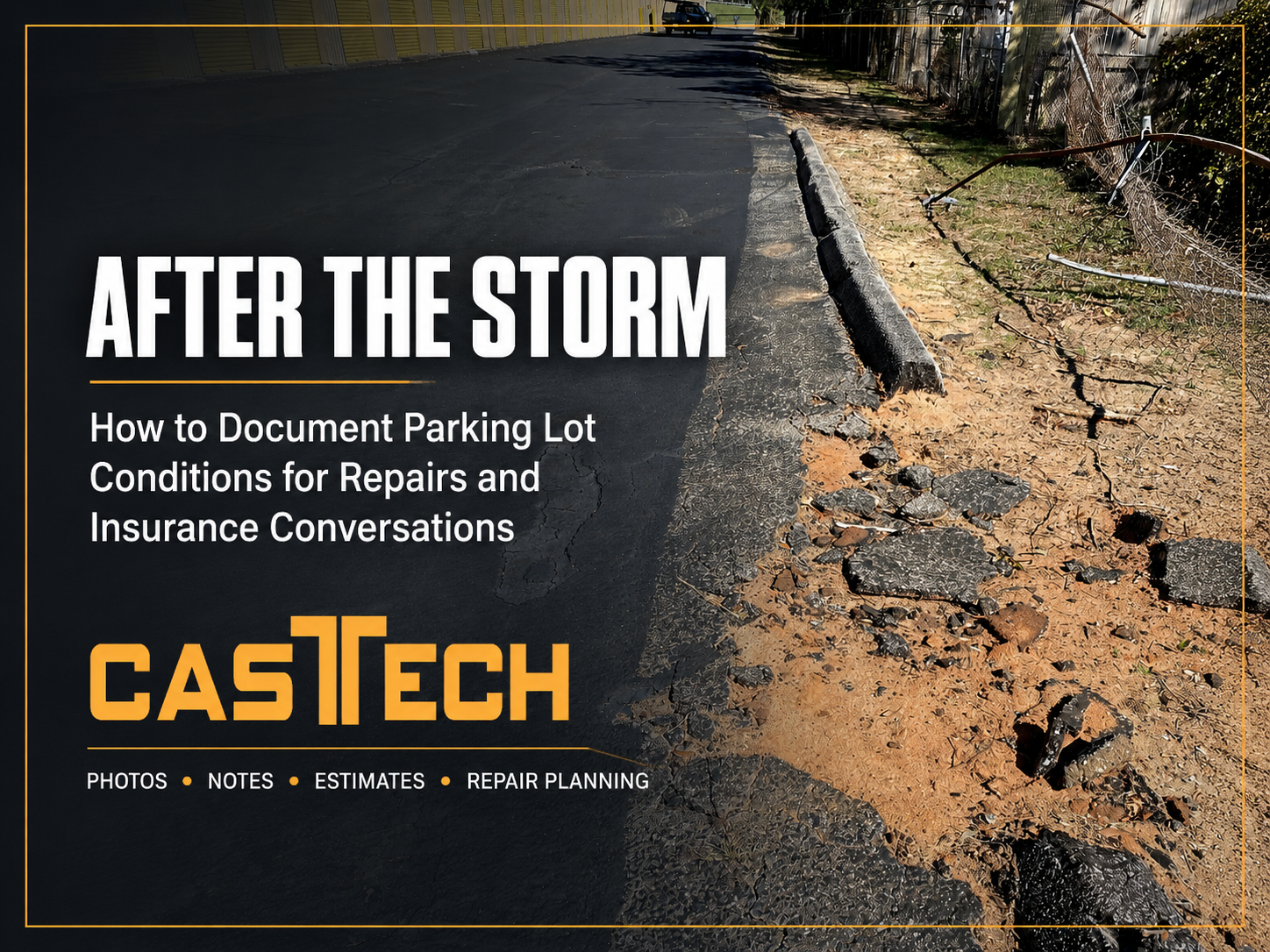
After a storm, we help property teams review visible pavement damage and plan the repair work within our scope. Access and immediate hazards come first: follow the responsible authorities’ instructions and wait until the property can be approached safely before arranging the pavement assessment.
Reopening access safely
Follow local authorities’ re-entry instructions and keep people away from unsafe areas. Once the site can be approached safely, our site review can document pavement concerns and recommend a repair sequence. You can request that through our Site Review & Assessment.
- Establish an incident command point and limit access to authorized personnel only.
- Use cones, barricades, and signage to cordon off high-risk areas and direct traffic to safe lanes.
- Document conditions with time-stamped photos and notes to support insurance and liability records.
Identifying potholes, washouts, debris, shifted wheel stops, and damaged signs
Systematically scan the entire property, prioritizing areas with heavy vehicle or pedestrian use. Look specifically for:
- Potholes and cracking that create trip or vehicle-damage hazards.
- Washouts and undermined pavement where drainage overflow removed base material.
- Bulky debris—tree limbs, fencing, and building materials—that block lanes or hide hazards.
- Shifted or dislodged wheel stops and parking curbs that compromise parking layout and vehicle movement.
- Damaged signage or bollards that affect wayfinding, speed control, and safety messaging.
Checking fire lanes and emergency routes
Your facility’s emergency-response contact should coordinate uncertain fire or emergency access with local responders. Load capacity, major washouts, and structural concerns require the appropriate qualified assessment. We can coordinate approved pavement repairs after those requirements are established.
- Verify curb markings and signage are visible and intact.
- Open temporary bypass lanes only when they meet minimum width and turning-radius needs for emergency vehicles.
- Record any obstructions and the steps taken to mitigate them for emergency and insurance documentation.
Reviewing ADA spaces and pedestrian paths
Accessible parking, ramps, curb cuts, and pedestrian routes must be inspected and restored as a priority. An inaccessible route creates legal and safety risk and can delay tenant operations.
- We can assess the pavement and layout around accessible stalls and access aisles once the area is safe to inspect.
- Our team reviews visible ramp damage and transitions and coordinates repair or design questions with the responsible project professionals.
- Keep temporary pedestrian paths separated from vehicular traffic with clear signage and barriers.
Temporary controls vs. permanent repairs
After a storm you’ll need a mix of temporary controls to restore safe operation and a prioritized plan for permanent repairs. Temporary measures lower immediate risk; permanent repairs restore long-term function and value.
- Temporary controls: the responsible qualified team should select access restrictions, signs, and any stabilization measures for the actual conditions. Do not reopen a washout or suspect pavement on the strength of a surface fill alone.
- Permanent repairs: full-depth patching, regrading washout areas, replacing base material and pavement, resetting curbs and wheel stops, and replacing damaged signage or lighting.
- We can recommend a sequence for approved pavement repairs and temporary work-zone controls. Emergency, utility, or structural hazards remain with the responsible authorities and qualified specialists.
Talk with us about the pavement repairs
Once the area can be assessed safely, we can discuss visible pavement damage, the repair sequence, and coordination with the other professionals involved. Emergency, utility, and structural hazards need to be addressed by the responsible authorities and qualified specialists.
Contact us or call (850) 860-0014 with the property location and the concerns you have. We’ll confirm our availability and the appropriate next step before a visit or repair is arranged.
Follow the authorities’ re-entry instructions and the safety guidance in Ready.gov’s flood resources.