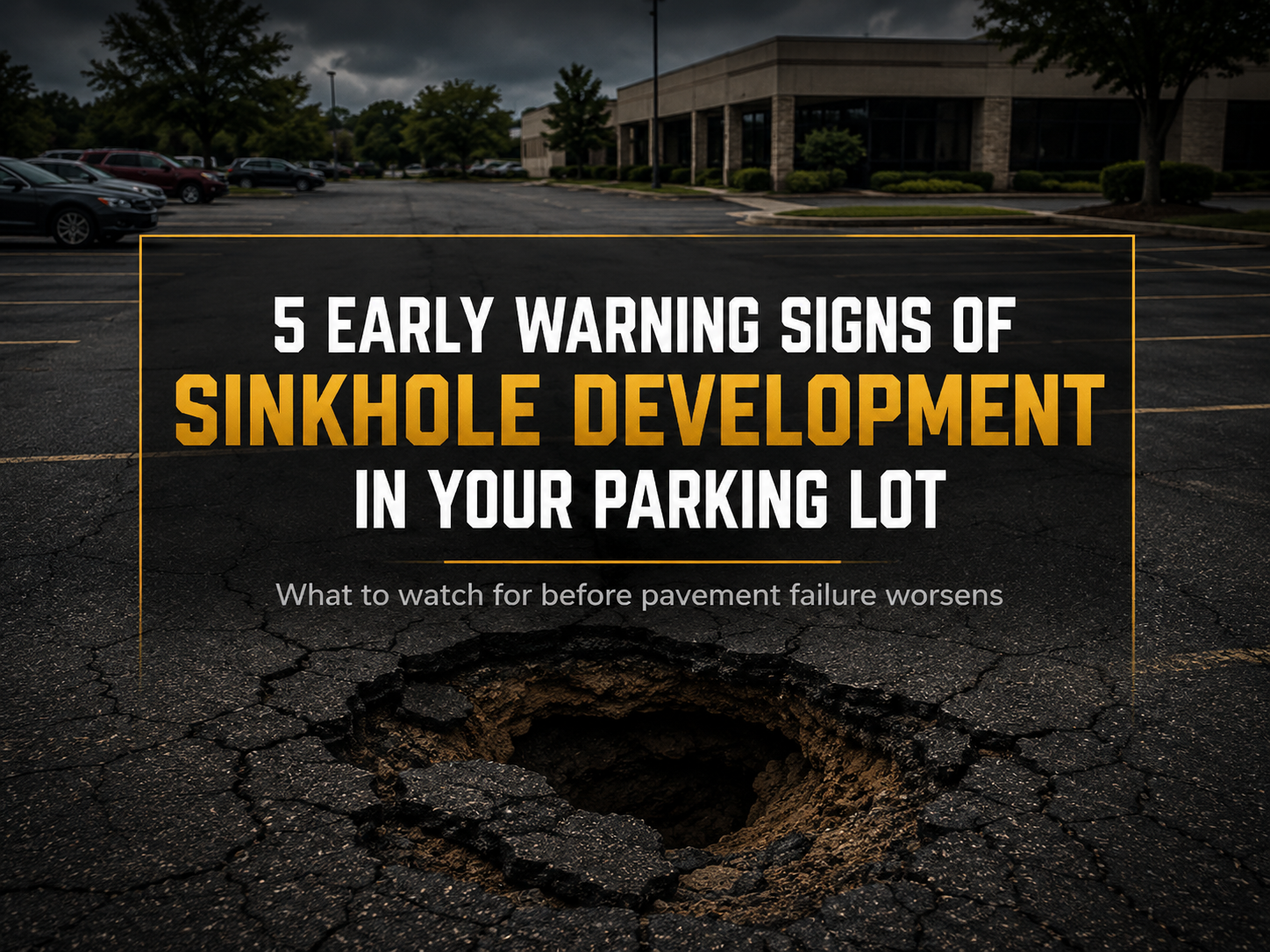
New settlement, a widening crack, or a sudden depression in a parking lot deserves attention. We help property owners document visible pavement concerns and plan the repair work within our scope. Suspected underground voids or unstable ground need the appropriate specialist assessment before a pavement repair can be planned.
Surface cracks that widen or lengthen
Hairline cracks are common, but cracks that rapidly widen, step-out from existing joints, or continue growing over weeks indicate subsurface movement or loss of support beneath the pavement.
- Watch for widening gaps, stair-step cracking through layers, or cracks that form concentric patterns.
- Photograph visible changes from a safe location and record when you noticed them. Leave close inspection and testing of suspect pavement to qualified professionals.
- Restrict heavy traffic in affected zones until a professional assessment confirms pavement stability.
New or sudden depressions in the pavement
Localized dips, bowls, or sudden low spots—especially if they deepen over time—are among the clearest surface signs that voids or soil loss may be developing beneath the lot.
- Record the apparent location and size from a safe distance. A qualified professional should assess the depression’s depth and underlying cause.
- Keep people and vehicles away. Have authorized personnel establish a restricted area only if they can do so without approaching unstable ground.
- Contact us to request a prioritized site review if you see active settling.
Settling or misaligned utility access and structures
Manhole covers, catch basins, valve boxes, and curbs that sit lower than surrounding pavement or develop gaps around edges often mean supporting soil has been washed away or compacted unevenly.
- Report visibly displaced utility lids, grates, or curbs to the responsible utility or site contact. Do not step or drive on a suspect cover to test it.
- Report and barricade openings immediately to avoid injury and damage.
- Coordinate with utility owners and include their findings in a CasTech site review to clarify cause and responsibility.
Persistent drainage problems and new ponding
Changes in drainage patterns, recurring ponding after storms in previously dry areas, or pooling near inlets can indicate undermining of subgrade soils or failing stormwater lines—common contributors to sinkhole formation.
- Note where water collects, whether flow paths have changed, and whether nearby drains are overflowing or clogged.
- Ask the responsible drainage or utility professional to investigate suspected failures. Keep observations to areas that can be viewed safely.
- Document occurrences after multiple storms to help technicians correlate surface water with subsurface loss.
Vegetation stress, sudden die-back, or localized growth
Trees, shrubs, or turf that suddenly yellow, slump, or develop unusual growth patterns may reveal shifts in subsurface moisture or soil movement caused by leaking pipes, eroding soils, or voids forming beneath the surface.
- Look for patterned stress (e.g., a ring or linear band) rather than random patchiness, which can point to underground leaks or subsidence.
- Note tree lean or exposed roots near paved areas—these are potential early indicators of soil loss.
- Share photos with inspectors to help link vegetation signs to pavement observations.
Responding quickly: inspection, mitigation, and prevention
Early, coordinated action reduces risk to people and property. Use a staged response: immediate safety measures, diagnostic inspection, and then targeted remediation informed by findings.
- Immediate safety: Keep people away from suspect areas and follow emergency or utility instructions. Authorized personnel should establish access controls from a safe position.
- Professional assessment: A CasTech site review can document visible pavement concerns and help plan repairs. Suspected underground voids or unstable soils may require a geologist or geotechnical engineer; utility issues need the responsible utility’s involvement.
- Typical remediation: targeted excavation, compaction grouting or injection stabilization, engineered backfill, and pavement restoration.
- Coordinate with utility owners when access points or pipes are involved, and maintain documentation and photos for insurance or municipal reporting.
Frequently asked questions
What typically causes sinkholes in parking lots?
Sinkholes develop when subsurface materials—old fill, poorly compacted soils, or soluble rock—are removed or eroded by water from leaks, storm drainage failures, or natural groundwater movement. Human activity, failing stormwater infrastructure, and local geology all play roles. Identifying the source (leak, erosion, or natural void) is critical to selecting the correct remediation.
How quickly should I act if I notice a warning sign?
A new depression, rapidly widening cracks, or displaced utility features warrant prompt professional assessment. Keep people and vehicles away and contact emergency services or the utility if there is immediate danger. Our site review supports pavement assessment and repair planning once the area can be approached safely.
Will a cosmetic patch fix a sinkhole?
A surface patch does not resolve an underlying void or unstable soil. A qualified specialist needs to determine the cause and stabilization requirements. We can then coordinate the approved pavement-restoration scope with the responsible project team.
What happens during a CasTech site review?
We document visible pavement concerns and discuss the repair questions that need to be resolved. A site review does not establish whether an underground void is a sinkhole or determine ground stability. The responsible geologist, engineer, or utility professional needs to assess those questions before we coordinate pavement-restoration work.
If an area appears unstable, keep people and vehicles away and contact the responsible emergency, utility, or qualified site professionals. Once the area can be assessed safely, contact us or call (850) 860-0014 to discuss the pavement-repair needs and our availability for your location. Florida DEP explains the distinction between sinkholes and other subsidence incidents.