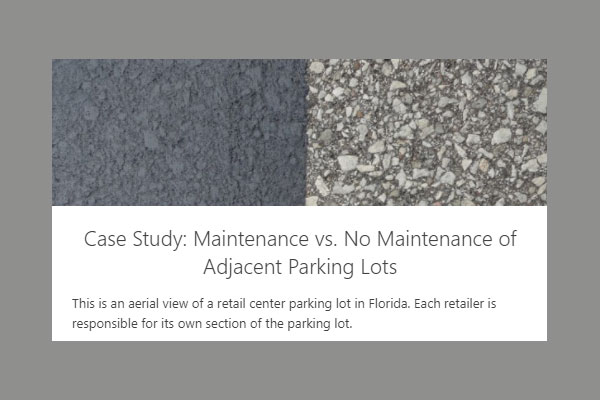

We share these pavement-maintenance examples from the Pavement Coatings Technology Council (PCTC) because they help explain why the timing of maintenance matters. The original compilation and photographic comparisons belong to PCTC; our role here is to connect those observations with the decisions property owners make about their own lots.
What the PCTC case study compared
The study presents side-by-side examples of similar asphalt areas followed over time: sections that received regular preventive maintenance (sealcoat applications and targeted crack repairs) versus adjacent or comparable sections left unmaintained. Photographic timelines highlight differences in surface color, cracking patterns, raveling, and overall serviceability.
Key observations and takeaways
- Sealed surfaces retain a darker, more uniform appearance. Sealcoating slows oxidation that turns asphalt gray and brittle.
- Proper preventive maintenance delays the onset and growth of cracks. Timely crack sealing keeps water out of the pavement structure and reduces subgrade damage.
- Unmaintained pavement shows faster progression of distress: alligator cracking, edge raveling, and potholes appear sooner where water and traffic are not addressed.
- Maintenance is most effective when it’s part of a program — inspections, targeted repairs, then surface treatments — rather than a one-off activity.
- Visual evidence in the PCTC examples supports a simple principle: small, periodic investments preserve pavement condition and reduce the need for costly reconstruction later.
Why preventive maintenance matters for commercial properties
For property owners and facility managers, pavement is an asset with a limited useful life. Preventive maintenance helps protect that asset by:
- Extending service life and deferring major repairs or repaving
- Maintaining aesthetics and curb appeal for customers, tenants, and visitors
- Reducing safety hazards from progressive distress (potholes, severe cracking)
- Managing lifecycle costs with predictable, scheduled work instead of emergency fixes
How we turn maintenance principles into a work plan
- Condition review: We document the pavement condition and recommend priorities and timing for professional treatment.
- Crack sealing: Our crew prepares and seals suitable cracks in the approved scope to limit water intrusion.
- Sealcoating: We prepare and coat suitable pavement as part of the agreed preservation plan.
- Targeted repairs: Our team assesses localized failures and performs the repairs included in your approved scope.
- Record keeping: Track dates, materials, locations, and observed performance so future decisions are data-driven.
How to use the PCTC findings on your property
- Start with a condition survey to identify distressed areas and prioritize interventions.
- Create or update a pavement maintenance schedule that sequences inspections, crack sealing, and surface treatments.
- Focus first on high-traffic and high-visibility zones where failure is most costly.
- Use small, planned investments to prevent larger capital expenditures later; the PCTC examples show visual proof that preservation works.
- Monitor treated areas over time and adjust frequency or materials based on performance and traffic loading.
Turn the findings into a plan for your property
We review the condition of your pavement and discuss the repairs and preservation work that fit its use. The PCTC examples provide background; your lot’s condition, traffic, drainage, and budget determine the proposal we prepare for you.
Contact us or call (850) 860-0014 to discuss your property and arrange the appropriate assessment.
Source material and photographic examples used for context in this summary are from the Pavement Coatings Technology Council (PCTC). We recommend reviewing the original PCTC compilation for the complete photo timelines and technical notes.